The Bigdata CLI is a command-line interface to the Bigdata.com REST API. It lets agents and developers query Bigdata Services from the terminal, pipe results into other tools, and orchestrate workflows in scripts or CI. Coding agents and automation pipelines work natively with shell commands. The Bigdata CLI exposes Bigdata Services in a form agents can call, parse, and compose without writing any HTTP client code, making it straightforward to ground agent workflows in premium financial content. It currently supports the Search and Knowledge Graph endpoints, with more services coming soon.
The Bigdata CLI is currently in Beta. We’d love to hear about your use cases: where you’re using the CLI, and any frictions you run into. Reach out at support@bigdata.com to help us shape what comes next.

Get started

1

Installation

The CLI is published on PyPI as bigdata-cli.
uv tool install bigdata-cli
Two entry points are available after installation: bigdata (full name) and bd (short alias).
2

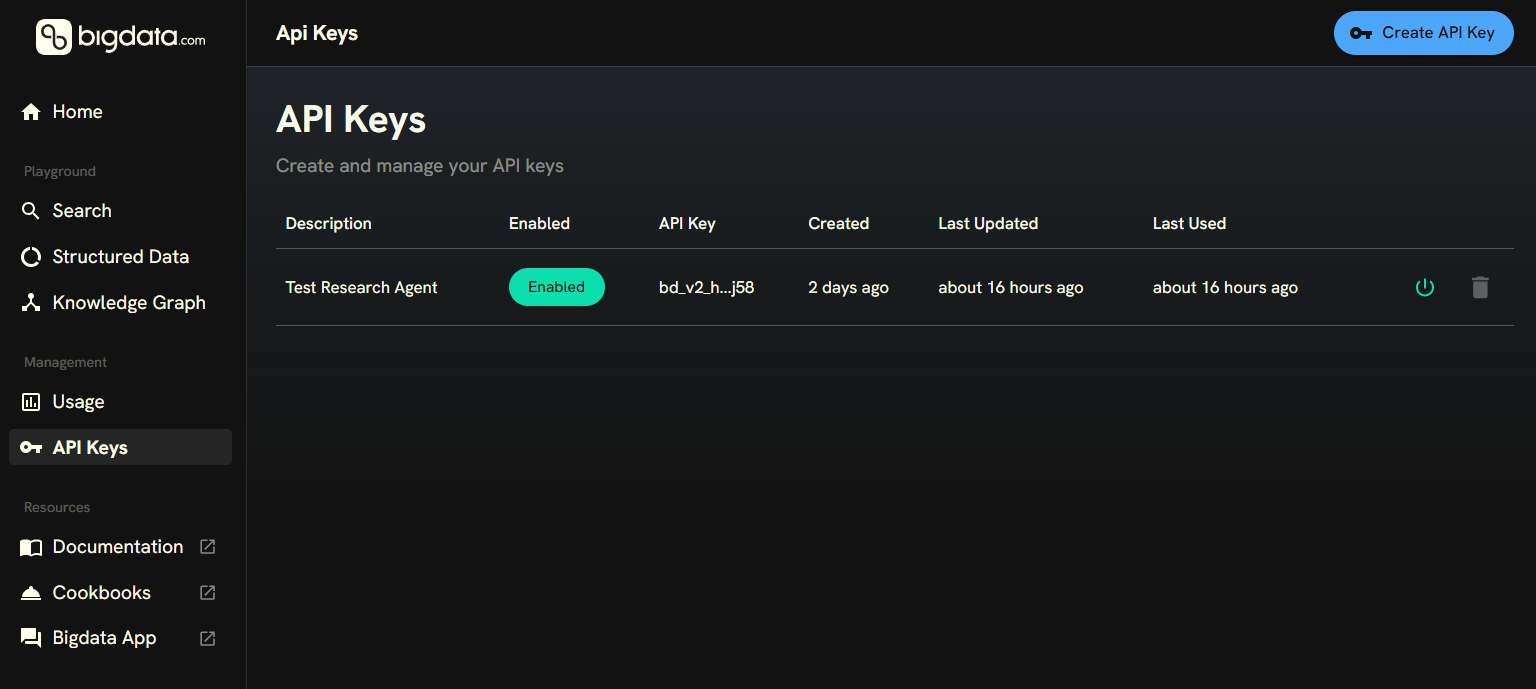
Create an API Key

You can create your API Key in the Developer Platform > API Keys.Developer Platform > API Keys
3

Configure the API Key

Run the interactive configuration command, which prompts for your key and profile (The default profile is default):
bigdata configure
For CI or scripts, configure non-interactively:
bigdata configure --non-interactive --api-key your-api-key
Or set the key via environment variable instead:
export BIGDATA_API_KEY=your-api-key
4

Try it out

Discover the available commands:
bigdata --help
bigdata search --help
bigdata find --help
bigdata resolve --help
Run your first queries:Search across news, filings, and transcripts, returning the top 5 most relevant matched document chunks:
bigdata search run "Tesla AI chips" --limit 5
Discover entities in the Knowledge Graph (fuzzy search):
bigdata find companies "Apple"
Resolve a known identifier to a stable entity (deterministic lookup):
bigdata resolve isin US0378331005
bigdata search run "earnings" --entity-any-of DD3BB1 --limit 10
Aggregate signals over time:
bigdata search volume "Tesla" --date-start 2025-01-01 --date-end 2025-03-31
bigdata search co-mentions-entities "AI chips" --limit 10